Back
SQUARE ONE
Year: 2022
Category: Residential Architecture
Skills: Photoshop, Rhino, Illustrator, Revit, InDesign, Enscape, V-Ray, GIS
The architectural proposition draws on theories from the degrowth movement and examines its implications for architecture and design. Current debates around socioeconomic restructuring urge us to acknowledge the limits to unsustainable economic growth. In recent years, some aspirational models have emerged as an alternative to the typical market-driven housing market, including Baugruppen (Berlin), co-operative housing in Switzerland, and the Nightingale Housing model (Melbourne). The ongoing COVID-19 pandemic has further prompted a re-evaluation of our current lifestyle and values. Now is the time for a slowdown to interrogate how to do more with less while still achieving a high quality of life. The narrative of housing for growth is that housing not only satisfies basic human needs, such as shelter, security, and sociability but is also a commodity that individual owners can acquire as a quasi-asset. In degrowth theory, housing is a right, and so is housing that improves well-being. Sustainable development is about energy efficiency and using materials but is also linked to quality of life and livability.
Define Degrowth
“Degrowth” is an ideology that denounces capitalism and unjust economic growth. It critiques growth at any cost, causing permanent destruction to the environment and society. (Demaria, D’Alisa & Kallis, 2015)
The degrowth movement generally calls for [1]Sustainable growth that protects and nurtures the natural environment. [2]Descaling consumption and production from developed countries, in turn, helps the less developed or developing countries achieve a better standard of living while maintaining sustainability and social equality. [3]A true democratic political system. [4]Self-sufficiency instead of relying on technology to solve ecological problems. [5]Open and localized market.
...a systemic change, not only in the economic operation but also in the culture and the ways of living. (Barlow et al., 2022)
In the built environment context. The movement promotes densification in planning and housing that divorces from individualism, including the amount of land consumption and encourages shared and flexible spaces. To reduce urban sprawl, dwelling spaces must be built within the inner urban boundary. Refurbishing and retrofitting are prioritized before building new.
Trending away from centralized planning policies and growth towards local independence, degrowth theorists argue that this thinking could solve the global housing crisis. (Nelson, Schneider, 2019)
----
Demaria, F., D’Alisa, G., Kallis, G. DEGROWTH: Vocabulary for a New Era. London, UK. Routledge. 2015
Barlow, N., Regen, L., Cadiou, N., Chertkovskaya, E., Hollweg, M., Plank, C., Schulken, M., Wolf, Degrowth & Strategy - How to Bring About Social-Ecological Transformation. London: Mayflybooks, 2022
Nelson, A., Schneider, F., Housing for Degrowth Principles, Models, Challenges and Opportunities. Routledge, 2019.
Stefansdottir, Harpa, and Jin Xue. “The Quality of Small Dwellings in A Neighborhood Context.” In Housing for Degrowth Principles, Models, Challenges and Opportunities, edited by Anitra Nelson and François Schneider, 171 - 182. Oxford, UK: Routledge, 2019
Heindl, Gabu. “Urban Housing - An Overview of Strategies for Social - Ecological Transformation in the Field of Urban Housing.” In Degrowth & Strategy - How to Bring About Social-Ecological Transformation, edited by Barlow et al., 227 - 234. London: Mayflybooks, 2022.
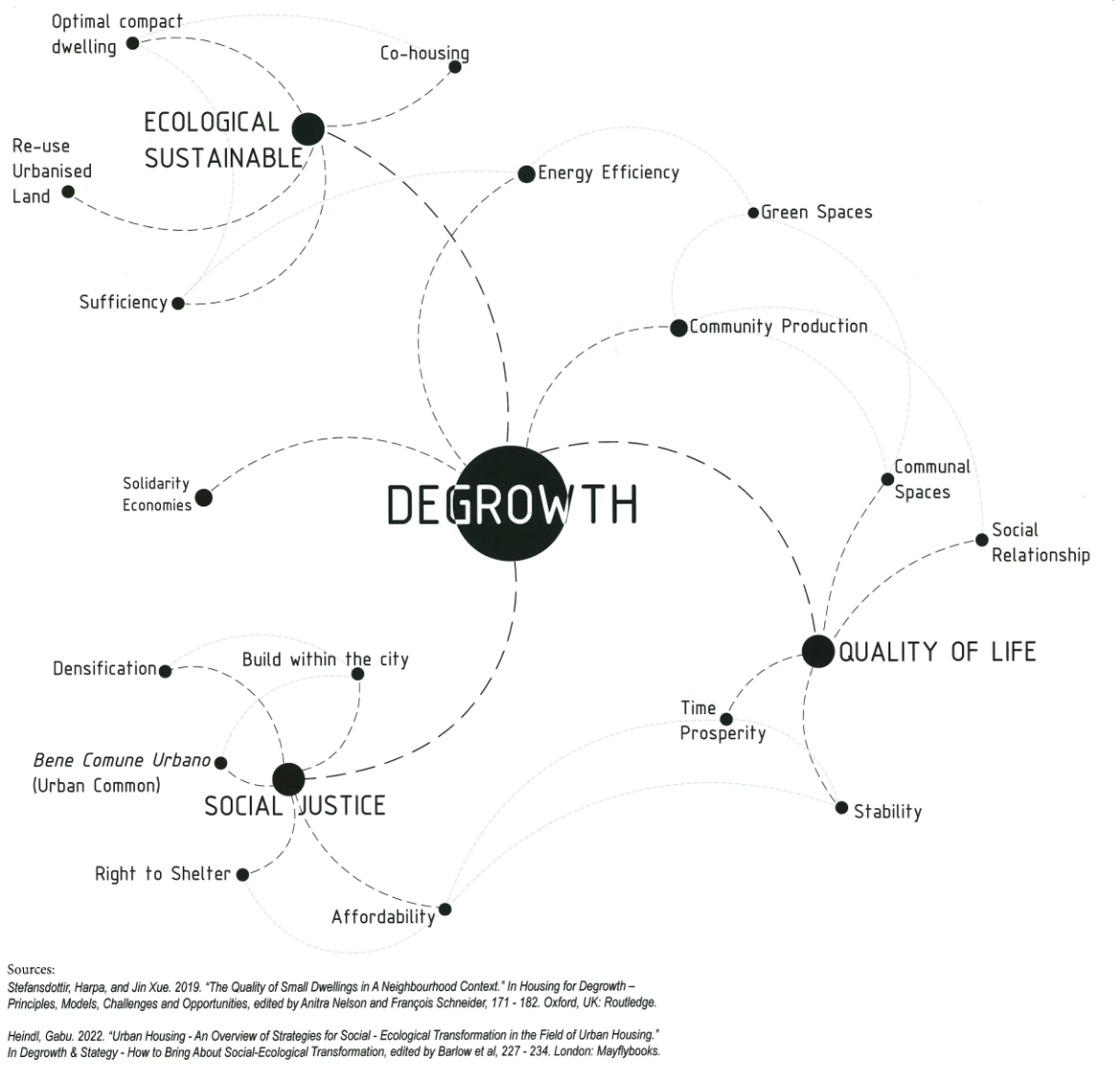
Spatial Diagram - Degrowth Theory
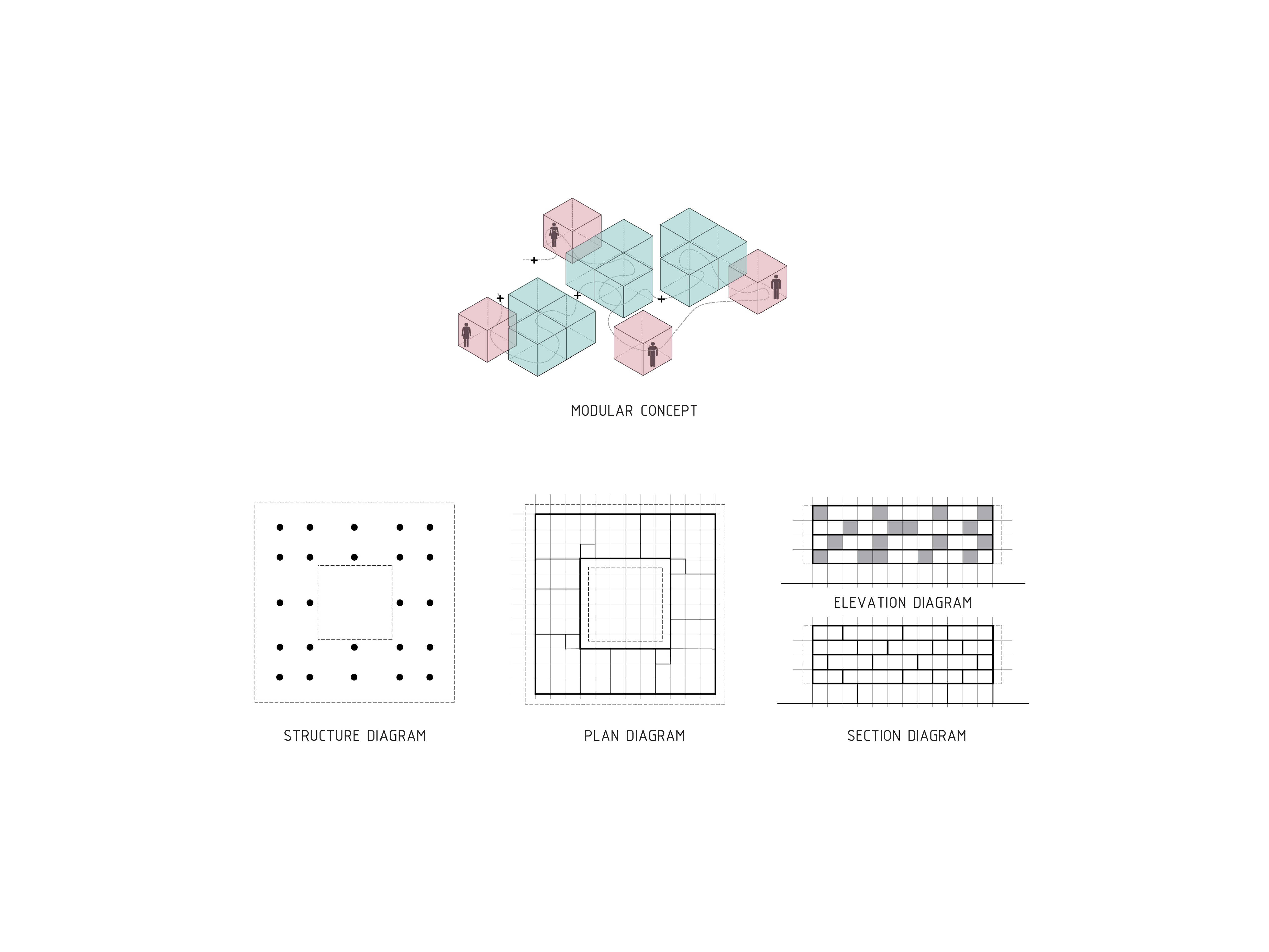
Design Concept
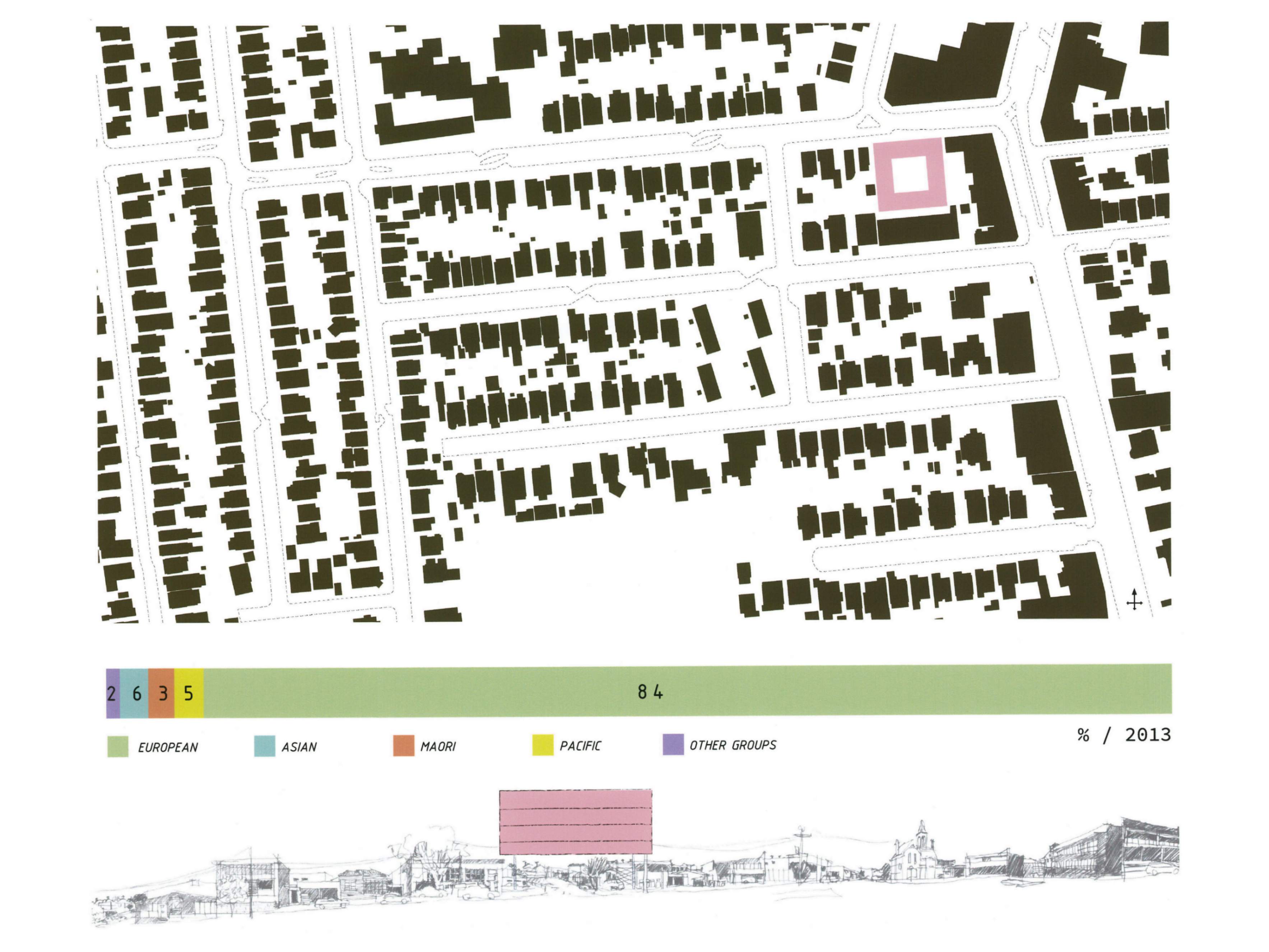
Contextual Concept
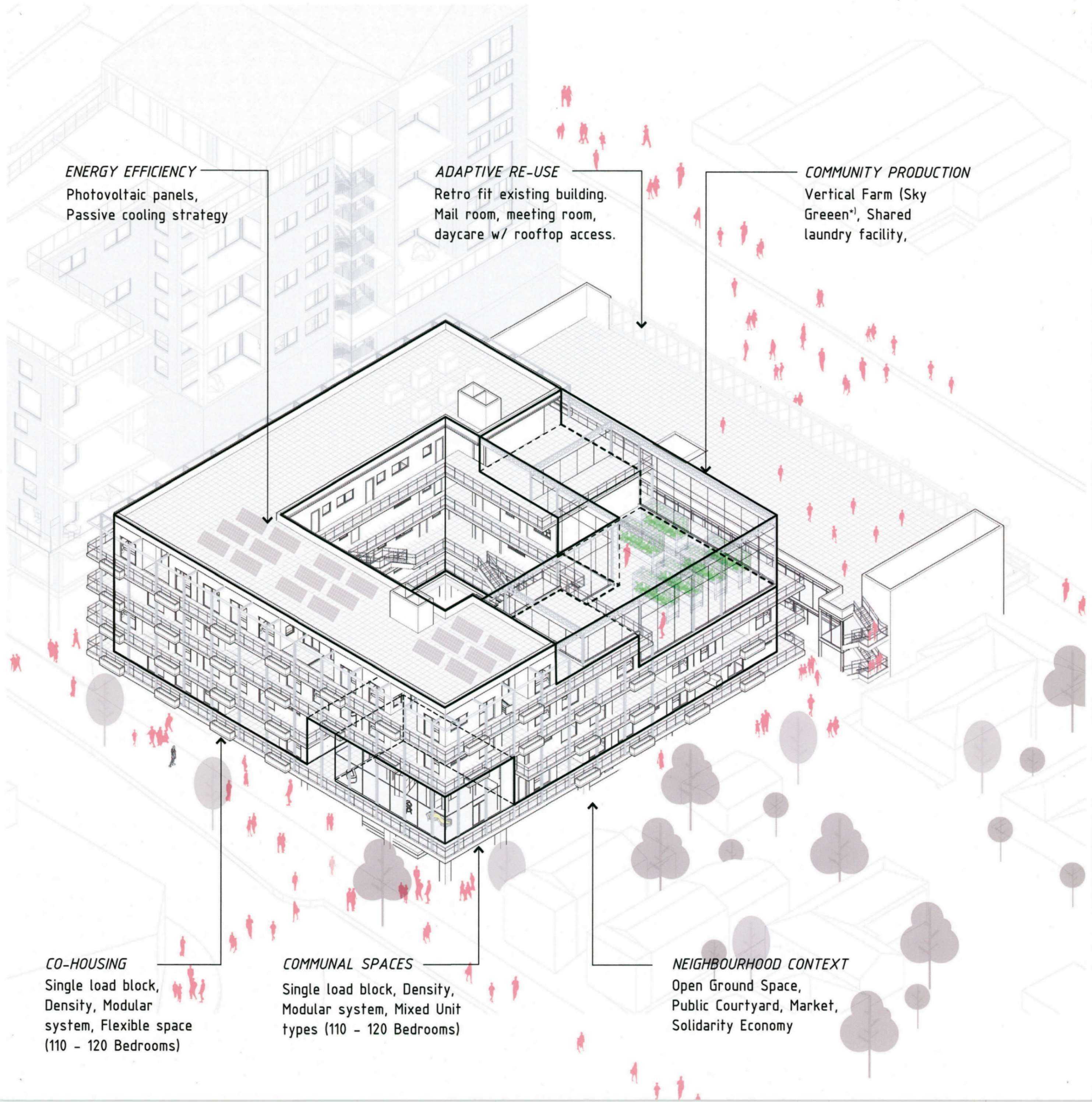
Programatic Diagram
This studio intends to design for a post-growth society and experiment with life, work, and play models that reinvent current approaches to density in Ponsonby, Auckland City. The area is heavily gentrified and is now one of the most expensive and affluent suburbs. The proposal is a collective housing complex that applies a modular system for compact living, spatially and economically, based on Stefansdottir and Xue’s The Quality of Small Dwellings in a Neighborhood Context, which argues for the importance of compact dwellings in urban densification, energy efficiency, and combating urban sprawl.
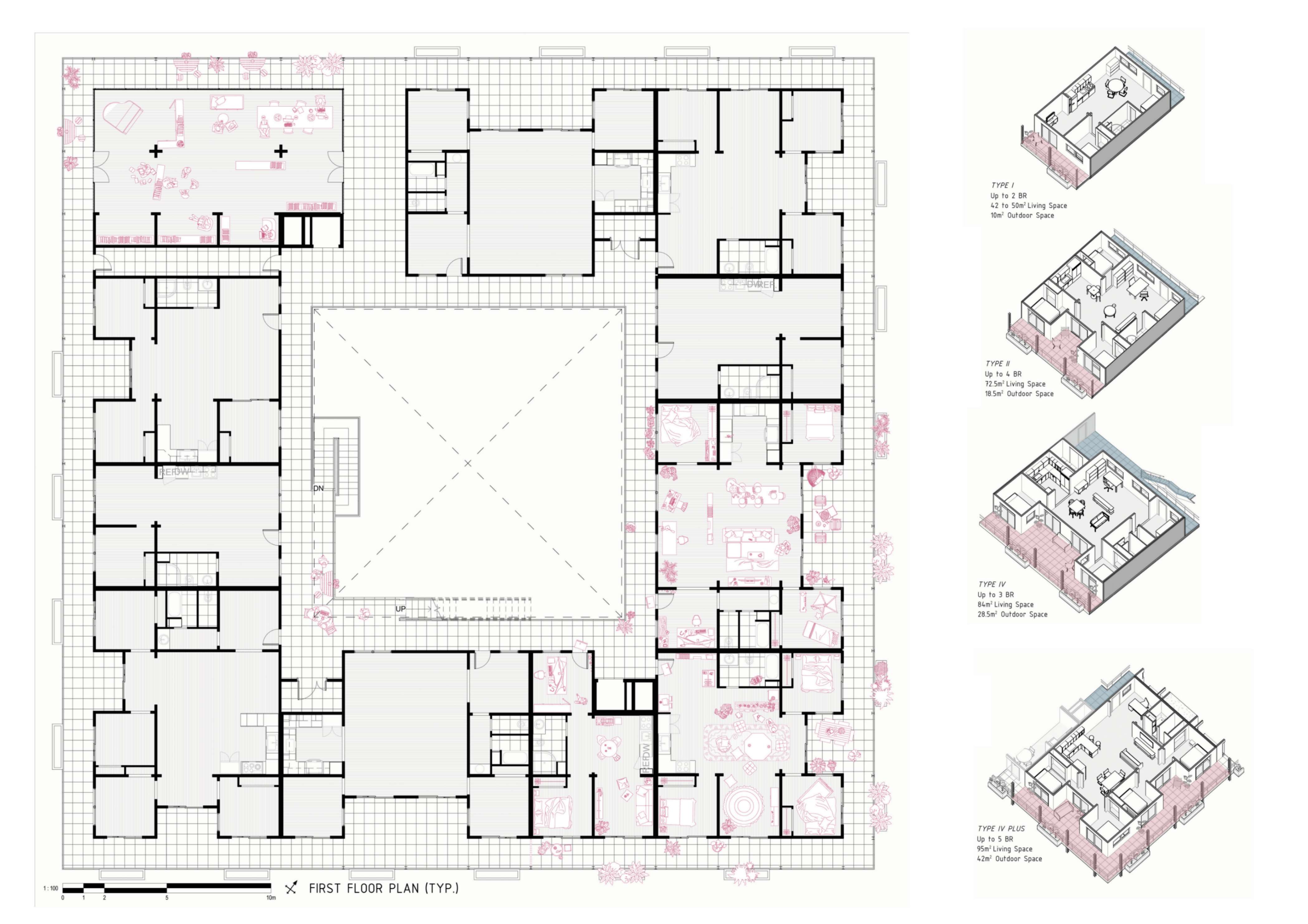
Typical Floor Plan & Unit Types.
The complex features a variety of unit types, allowing a diverse mixture of tenants, culturally and socially. Wood and brightly colored materials make the mass appear lighter in scale. The modular system is constructed with fixed dimensions of Smart Structure Insulated Panels (SIPs) to allow for its reuse once deconstructed. The design strategies follow strict orders based on isotropic grids in responding to existing site conditions to reveal a generic, common, and timeless architectural language.
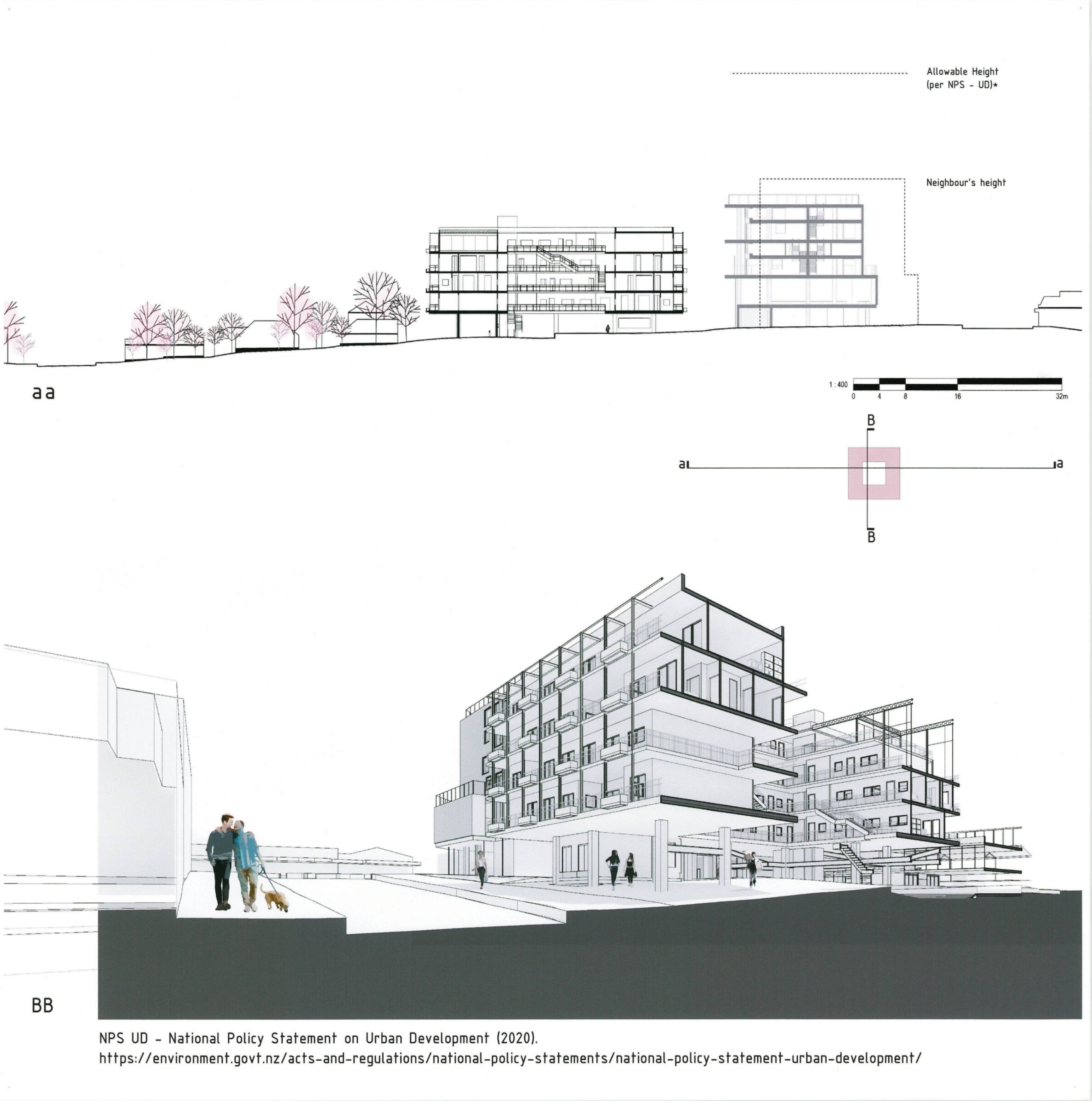
Sections
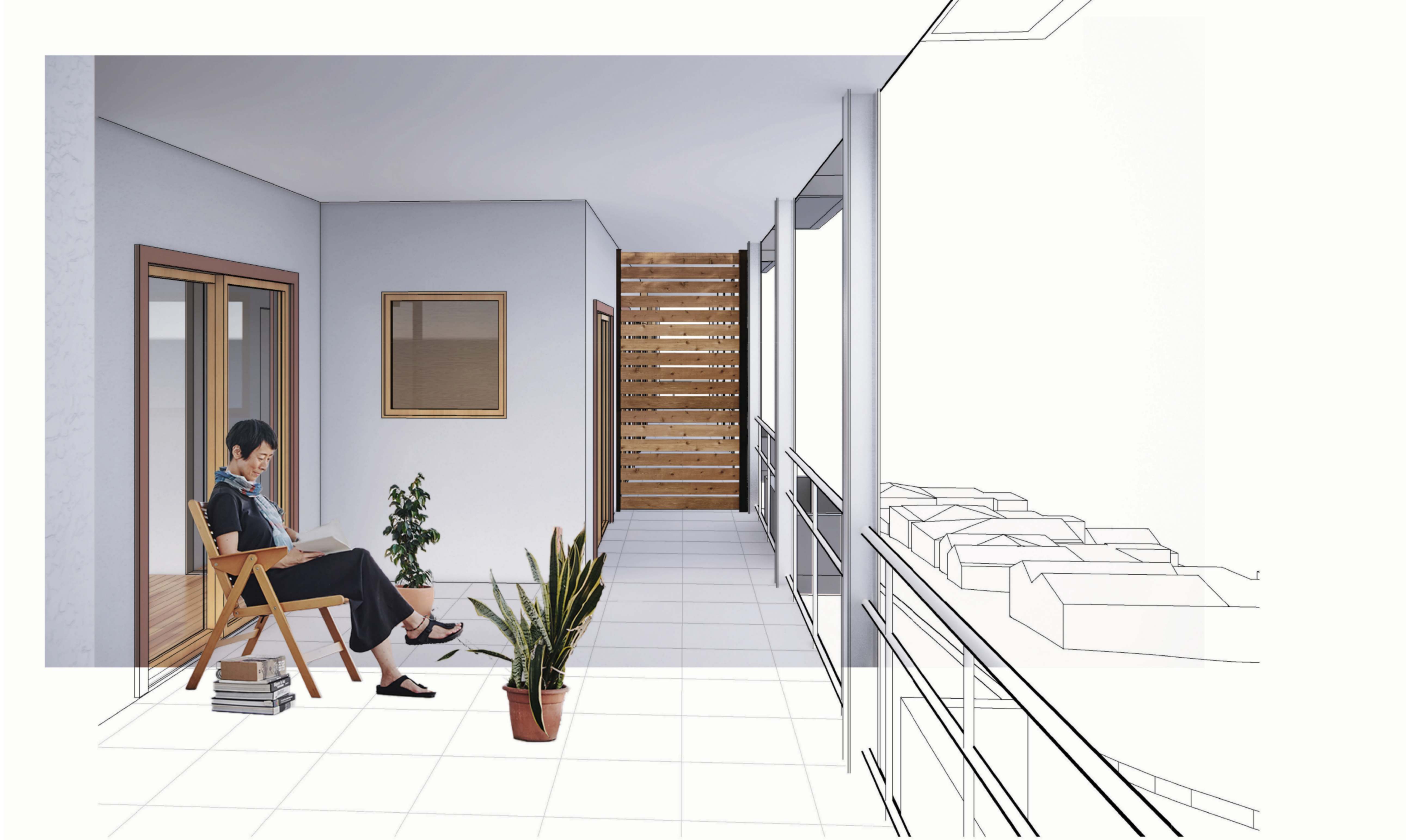
Gallery View
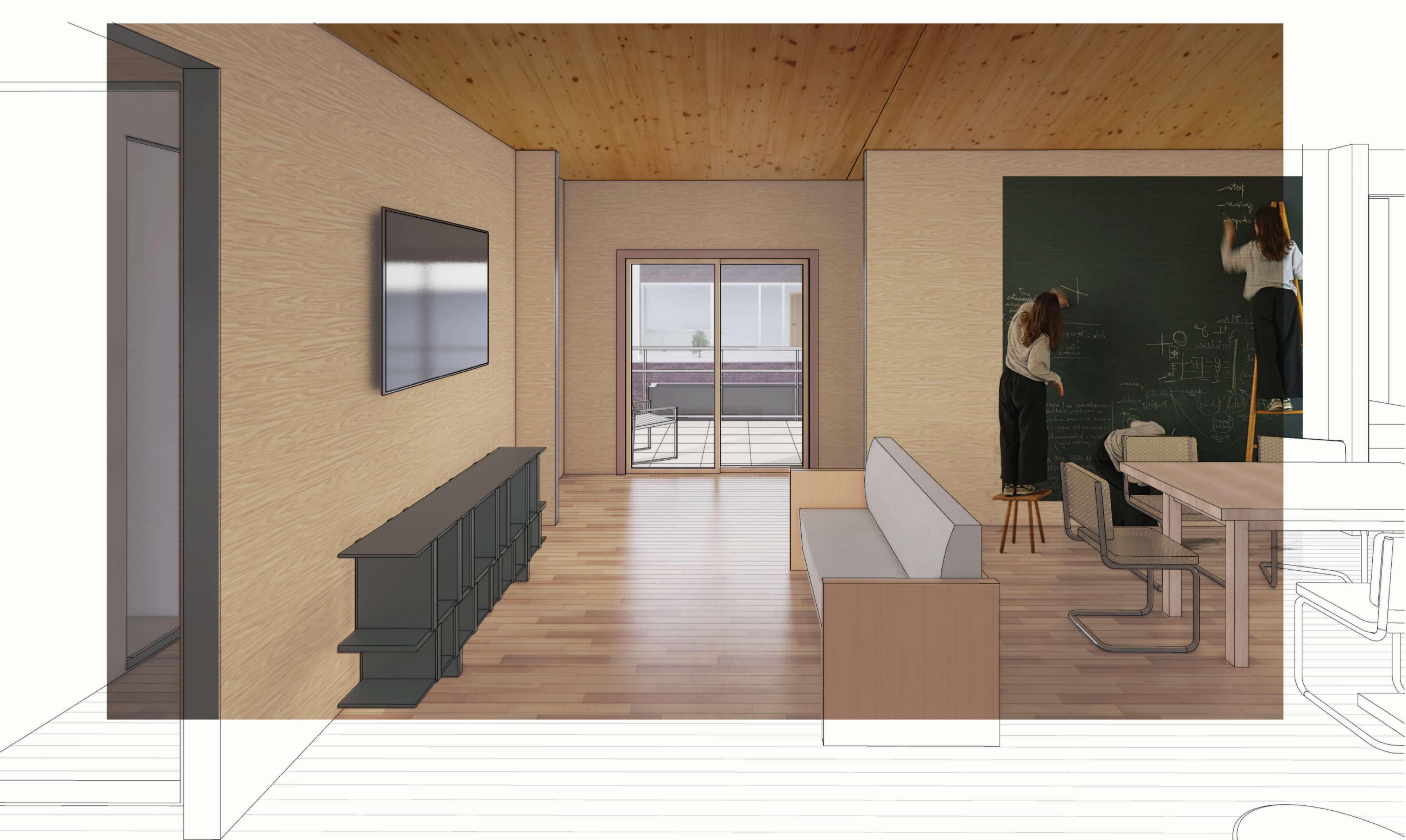
Interior View
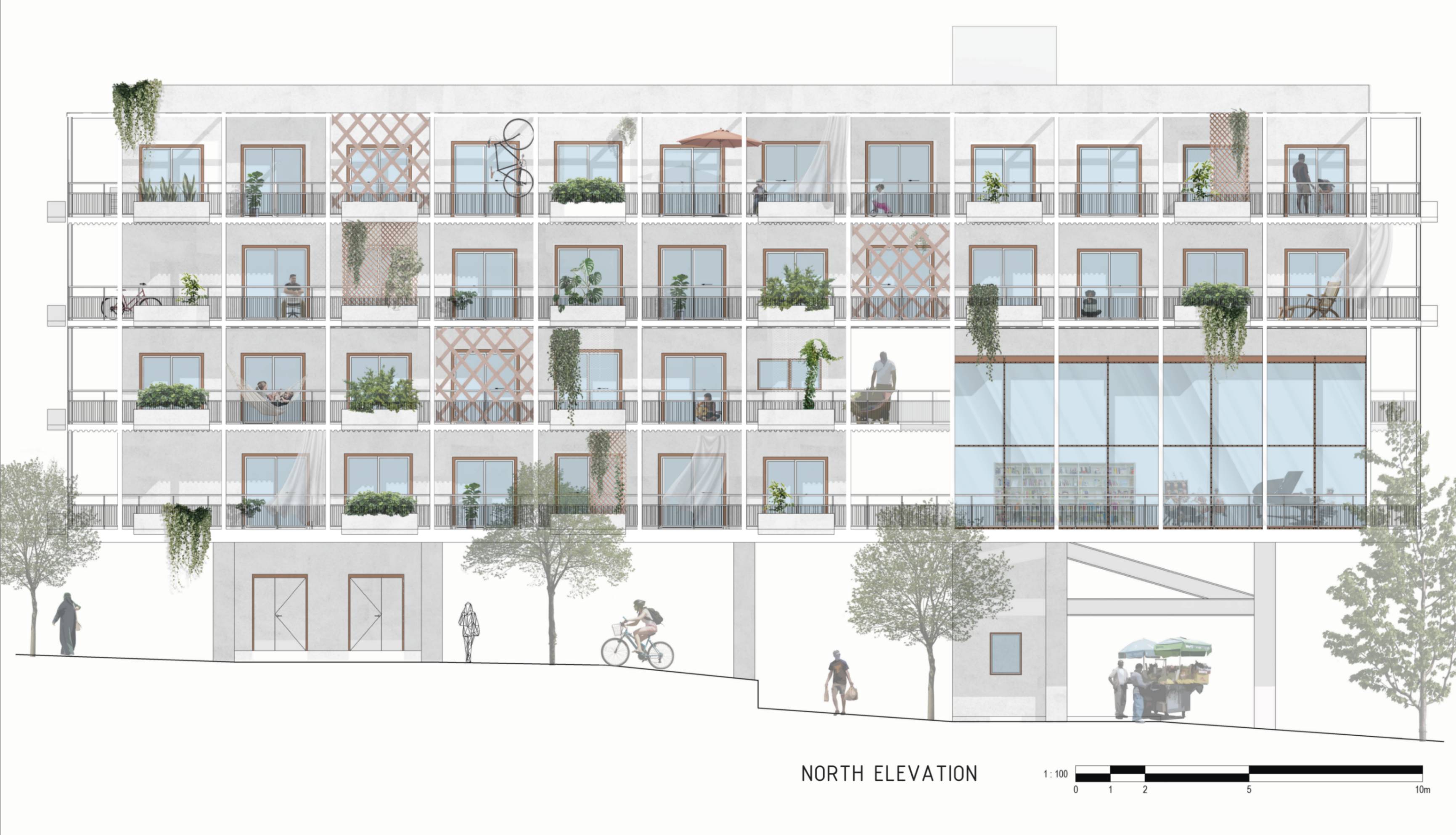
Elevation

AN LE
More by AN LE
View profile