Back
Know Tree: Nature Cultures Painting
Knowing Tree
Life Support
A place I go to run away,
To hide,
To feel a sense of freedom when I feel trapped.
Alone, no longer alone.
I climb above it all.
Putting it all in perspective.
Let the fear recede to the background.
Each step I take,
Each branch I climb upon,
I shed layers of anger, confusion, and tears.
For hours I stay,
It feels like a lifetime,
I sway with tree as the wind awashes our beings,
Drying my face.
A distant calling grounds me back to the earth.
My mother.
But I am already home.
Mother tree.
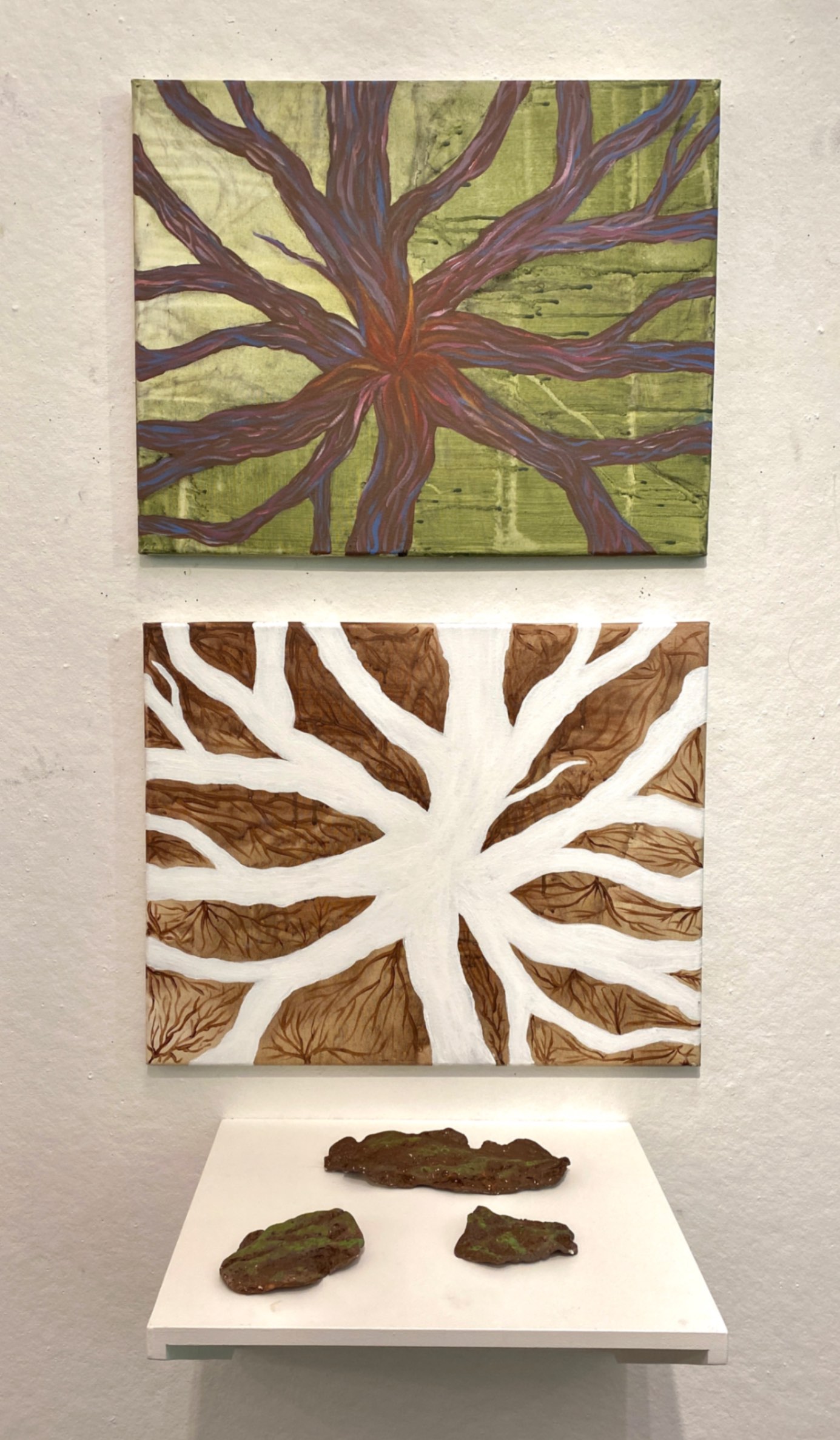
Reflecting on the relationships I have established with trees in the past, and their role in my life as guides, grounding vessels, climbing structures, and points of scientific analysis, I was curious about how trees view the organisms they interact with. This prompted questions such as how trees view people in both non-human inhabited spaces and human-centric spaces. I was additionally interested in flipping the perspective of how trees interact with the fungi kingdom in terms of whether trees are hosts for mycorrhizal networks or if the mycorrhizal networks instead support tree and facilitate tree to tree communication as presented in Suzanne Simard’s Finding the Mother Tree.
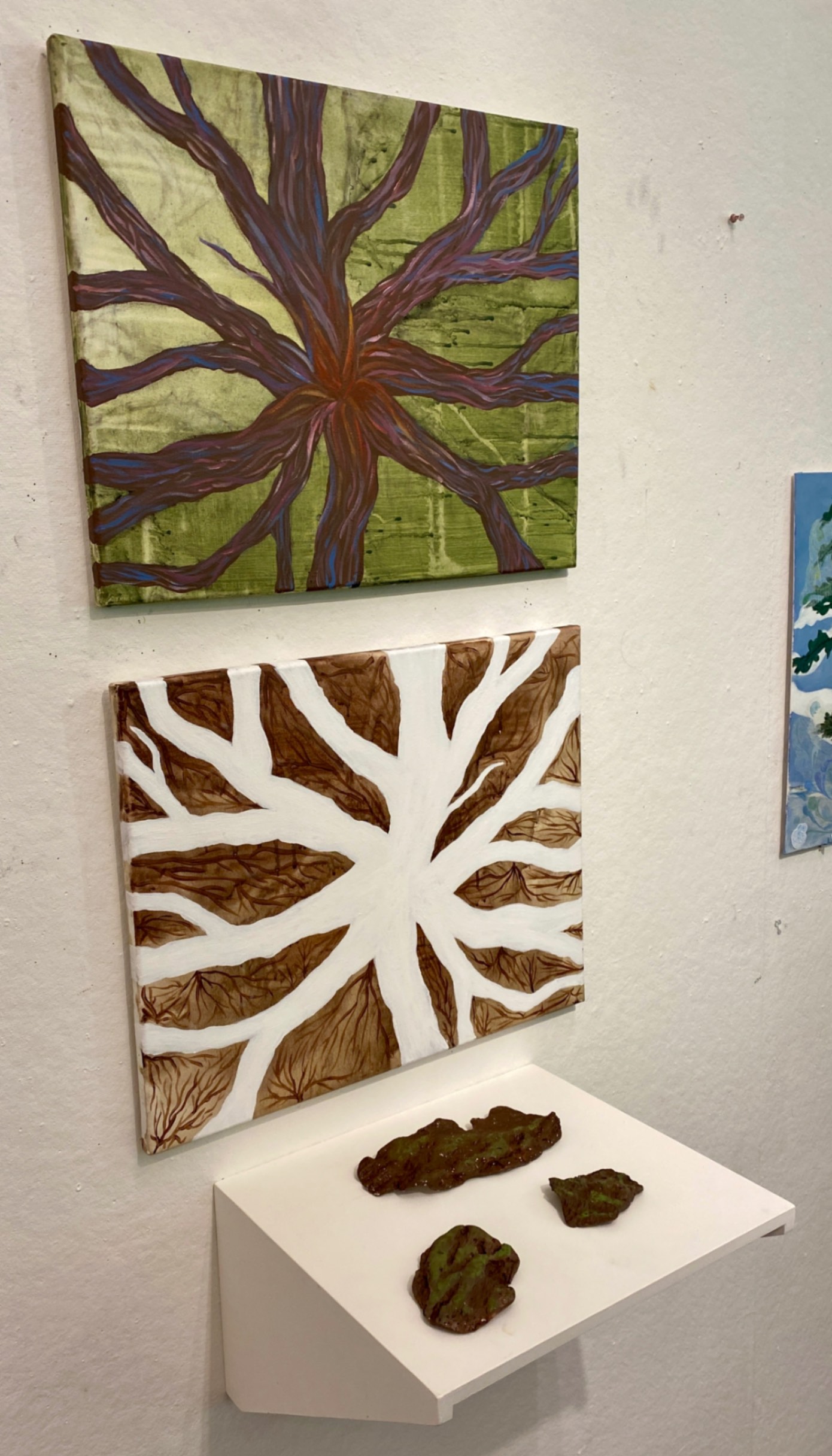
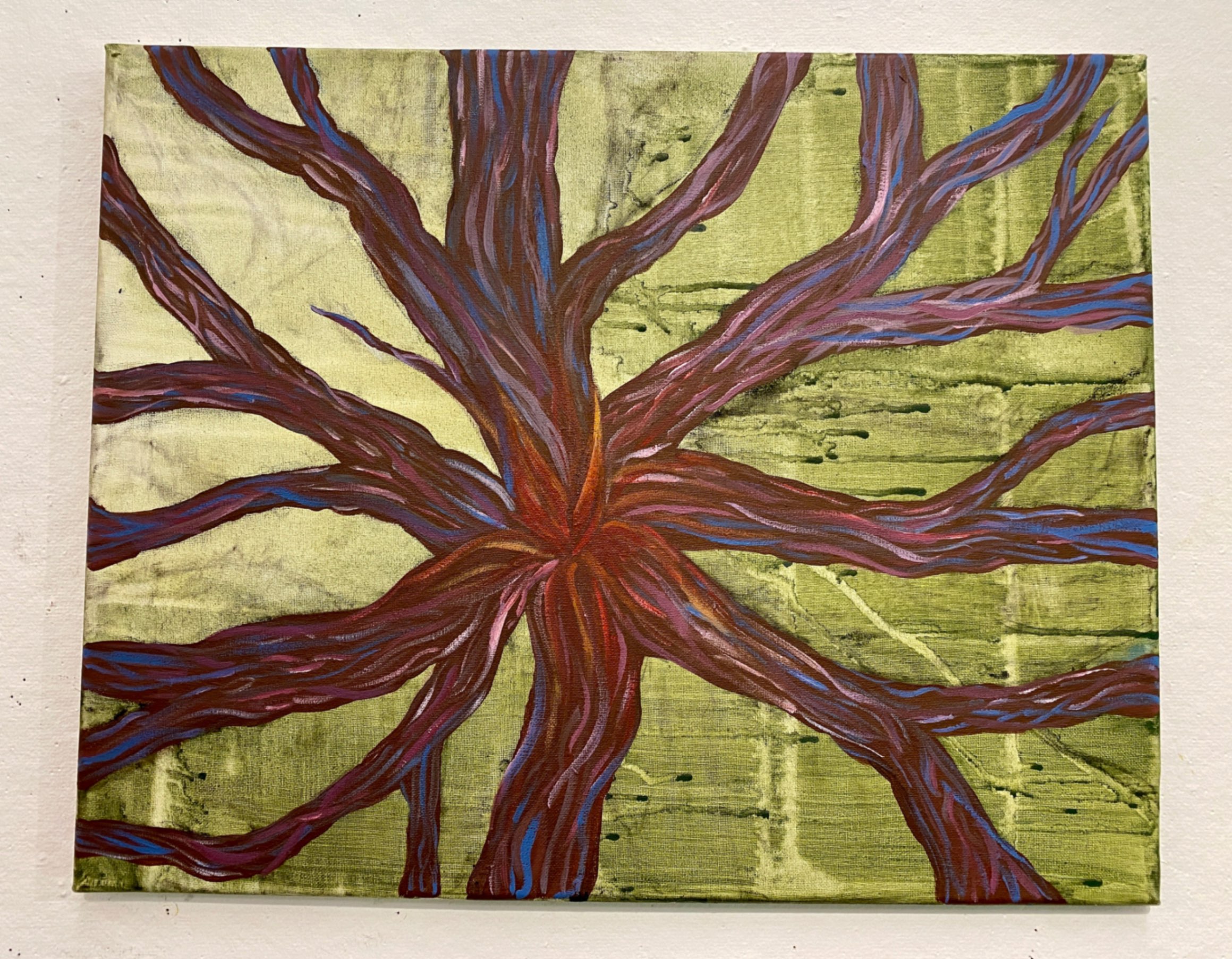
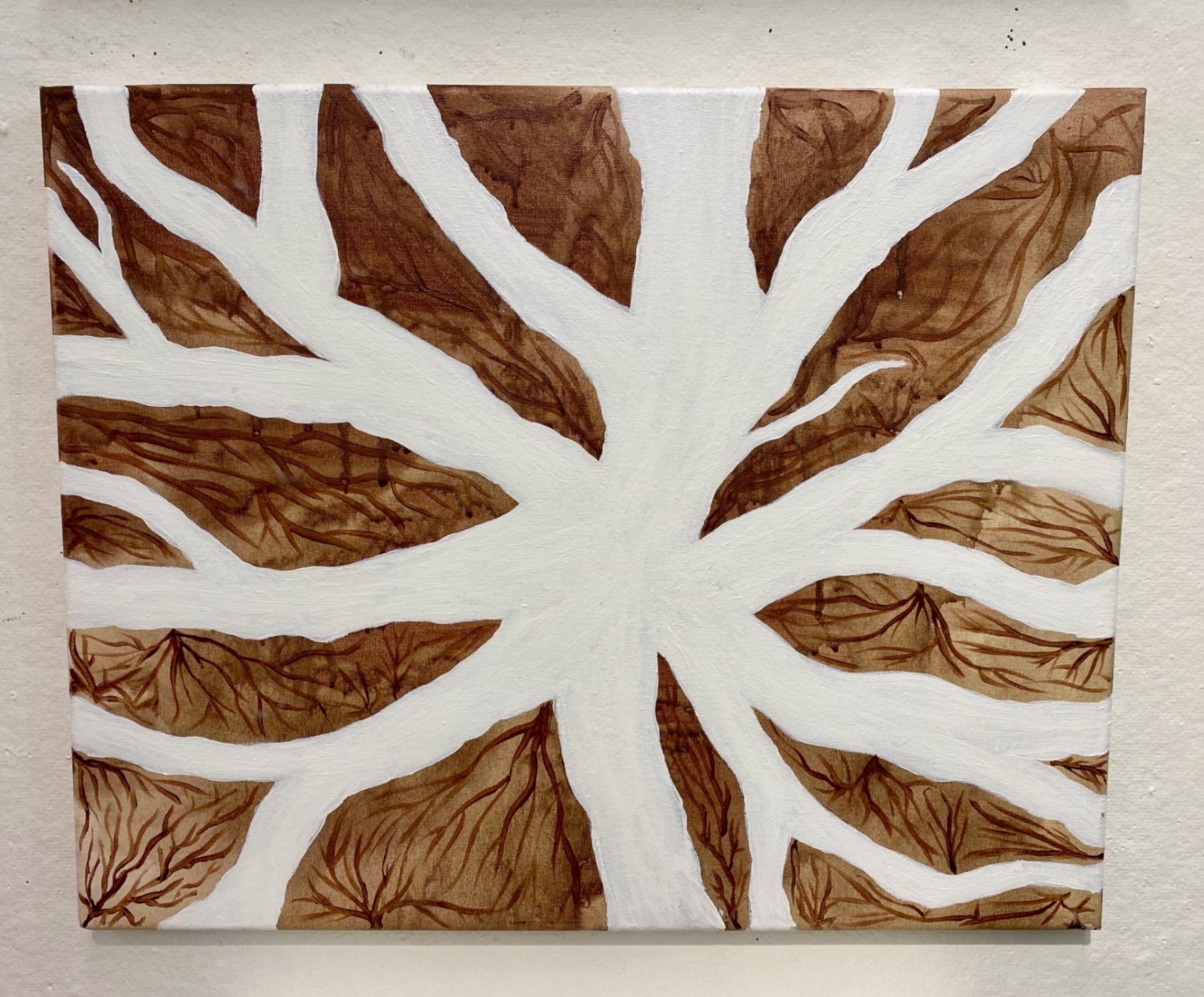
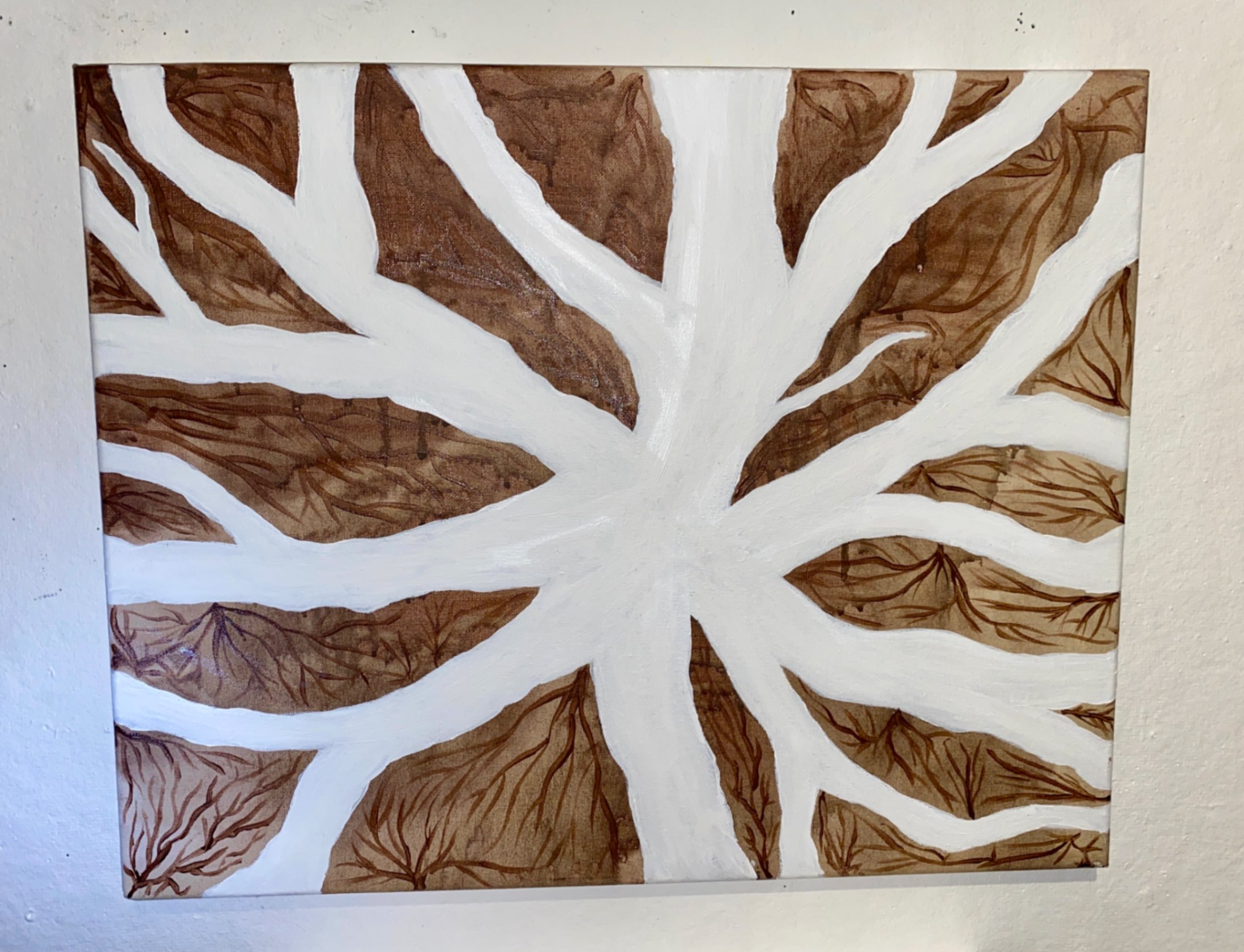
Conceptually I wanted to highlight both tree presence and absence, in terms of recongizng that the fungi communities have existed long before the trees and are resilient to many climatic and environmental changes. This led to my creation of a diptych; the first piece expresses how tree looks down and views humans and other land organisms, while the second piece illustrates the absent outline of tree surrounded by root systems and mycorrhizae existing beneath the surface. My color choice on the first pieces was very intentional: the blues and purples represent my awe and recognition of the complex systems of water relations and gas exchanges tree carries out, and the red tones symbolize the impact climate change, such as drought and wildfires. These colors were also inspired by a nighttime visit to the tree I selected for this project, a Northern Red Oak. In this moment, the street lights turned some of the leaves yellow-orange while the sky was intensely blue, right after the sun had gone down.
Returning to my first intuitive observation of tree, I had a full sensorial experience. Tree was both earthy, umami, decaying, musty, rough, smooth, striking, inviting, and protecting. Sitting with tree I heard birds chirping, wind rustling the leaves, someone humming, and people walking and talking in the distance. During my meditation practice and quiet time with tree I realized how the location was highly people-centered, tree was both part of a passageway and also interrupting the path with an immensely large and beautiful presence.
Entering tree’s presence, my ritual always included gratitude or a silent moment in awe. This often manifested as circling around tree, sitting down and noticing the intricacy at the base of tree, and gazing into the canopy. I sometimes found myself singing to tree as well; I believe music is a universal language that can communicate beyond not only language borders, but also the border between the plant, animal, and fungi kingdoms. I also had the unique experience of professionally climbing up into the tree canopy of many trees on campus including the Northern Red Oak; this was a significant factor in the perspective I chose in my project’s composition. My materials consisted of acrylic paint on stretched canvas and painted paper clay impressions of tree taken from varied points of the tree trunk.

Sakura Azzopardi
More by Sakura Azzopardi
View profile Arch Hive